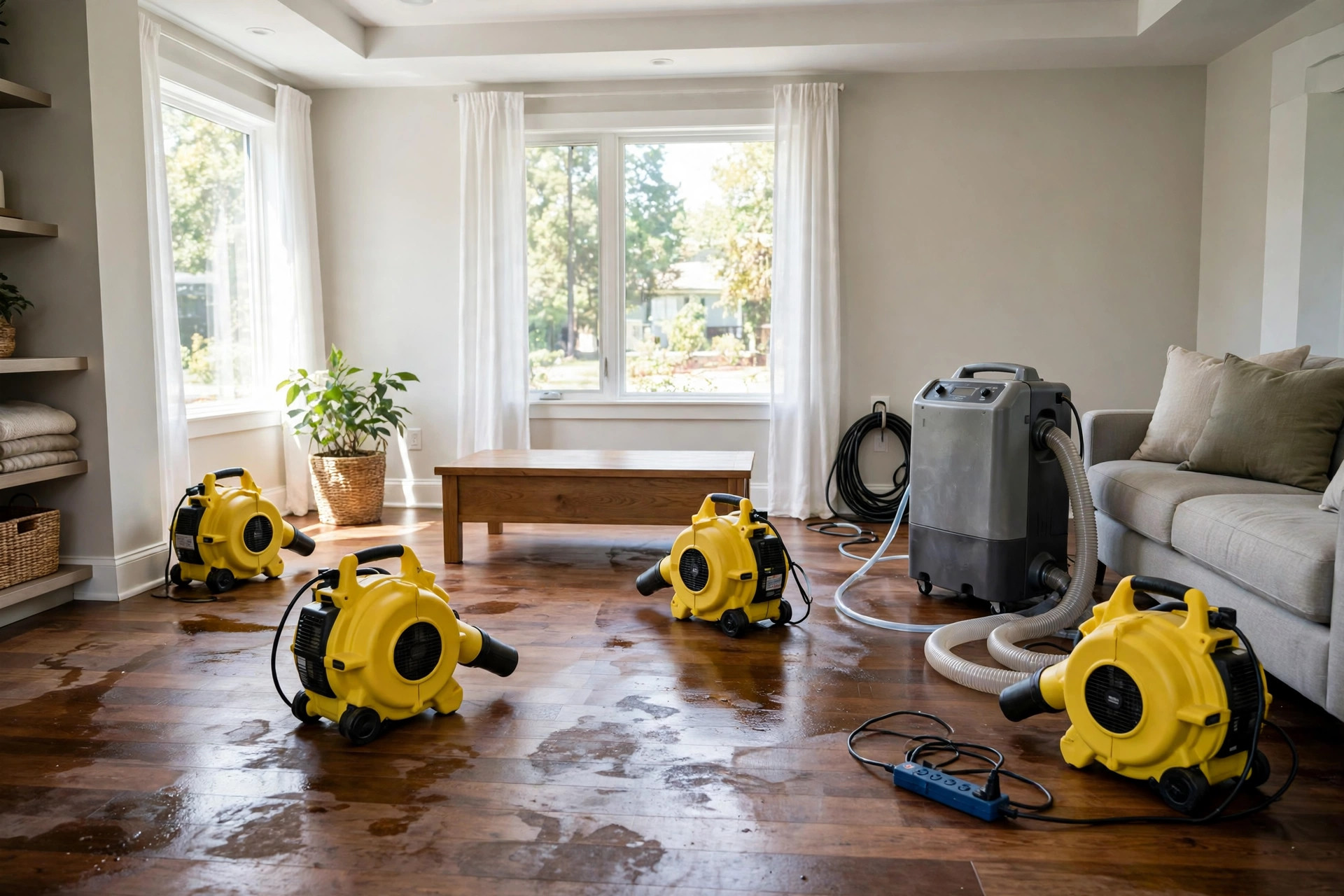
The honest short answer: most St. Louis homeowners pay somewhere between $1,300 and $5,700 for professional water damage mitigation, with the national average job landing around $3,455. Where your job falls in that range is mostly decided by two things — how much area got wet, and how dirty the water was. This guide breaks down the real 2026 numbers so you can judge any quote put in front of you.
The price by water category
The industry (following the IICRC S500 standard) sorts every loss into three categories, and each carries its own per-square-foot price for extraction, drying, and sanitizing:
- Category 1 — clean water (supply lines, sink overflows, rain): $3.50–$6 per sq ft. The cheapest outcome — most materials dry in place.
- Category 2 — gray water (washing machine, dishwasher, toilet bowl overflow): $5–$9 per sq ft. Contaminated porous materials come out; everything gets disinfected.
- Category 3 — black water (sewage backup, outside flooding, long-standing water): $7.50–$12 per sq ft. Containment, protective gear, and mandatory removal of every porous material the water touched.
Run your own numbers with the water damage cost estimator — pick your category and square footage and it applies exactly this table.
Worked examples
- A burst supply line wets 300 sq ft of first floor (Category 1): roughly $1,050–$1,800 to extract and dry.
- A washing machine floods a 400 sq ft laundry and hall (Category 2): roughly $2,000–$3,600.
- A sewage backup hits 600 sq ft of finished basement (Category 3): roughly $4,500–$7,200 for mitigation alone — before any rebuilding.
Mitigation is not the whole bill
Mitigation stops the damage from getting worse. Rebuilding — replacing the drywall, flooring, and trim that had to come out — is a second scope, commonly $20–$37 per square foot of rebuilt area. A quote that blends both without separating them is a quote you cannot judge. Ask for the two numbers apart.
What insurance usually does
Sudden, accidental water damage — a burst pipe, a failed water heater, an appliance line — is covered by most homeowner policies, minus your deductible. Water that came from outside the home (surface flooding) usually is not, unless you carry flood insurance. Either way, fast professional documentation is what claims are paid from: moisture readings, photos, and an itemized log of what was removed.
How not to overpay
- Get the category and the square footage in writing — those two inputs are the price.
- Ask what portion is mitigation and what portion is rebuild.
- Be wary of a full-job quote given over the phone, before anyone has measured moisture.
- Act fast anyway: every day of standing water moves the job toward a more expensive category.
Disclaimer: Find Water Damage Restoration is a free service to assist homeowners in connecting with local service providers. All contractors/providers are independent and Find Water Damage Restoration does not warrant or guarantee any work performed. It is the responsibility of the homeowner to verify that the hired contractor furnishes the necessary license and insurance required for the work being performed. All persons depicted in a photo or video are actors or models and not contractors listed on Find Water Damage Restoration.
Same-day and 24/7 emergency services are subject to provider participation, location, technician availability, and demand. Availability is not guaranteed and may vary by market and appointment capacity.